
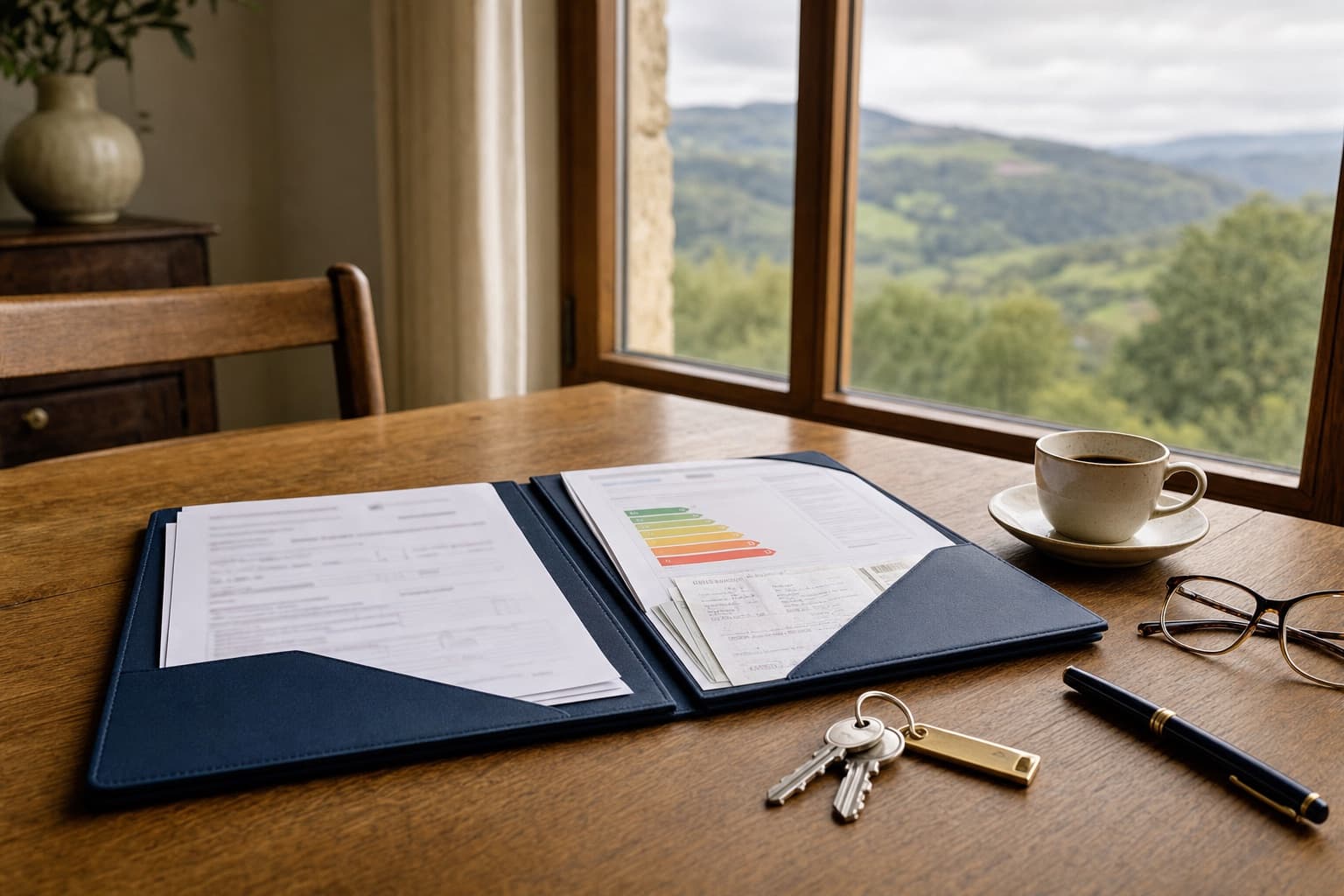
One of the most frequent reasons a sale falls through isn't the price: it's incomplete paperwork. When a serious offer arrives and a certificate is missing, the buyer cools off and, more often than not, finds another home. This guide is the official checklist we use at Faro before listing a property in Asturias.
Before you list (the bare minimum)
These three documents need to be in your folder before the listing goes live. Without them, the advert shouldn't even see the light of day.
1. Nota simple (land registry extract)
- What it is: a certificate showing who the owner is, whether the home has any charges (mortgages, seizures, easements) and its registered description.
- Where to get it: registradores.org (online) or at the registry in person. Cost: ~€9.02.
- Practical shelf life: technically it doesn't expire, but the sensible thing is to use one issued within the last 3 months.
- Why it matters: if there are undisclosed charges, the buyer can seek to rescind the contract.
2. Energy performance certificate (EPC)
- What it is: a compulsory document rating the home from A to G by consumption and emissions.
- Who issues it: a qualified certifying technician (architect, technical architect, engineer).
- Cost: between €70 and €180 depending on size and province (Asturias tends towards the upper end).
- Validity: 10 years.
- Compulsory registration: in the Principality of Asturias it is registered with the relevant regional department, which issues a registration number. Without that number, listing on Idealista or Fotocasa is not legal.
3. Latest council tax (IBI) receipt
- What it is: the Impuesto sobre Bienes Inmuebles, the Spanish equivalent of council tax. It shows you are up to date with the town hall.
- Where to get it: from your bank direct debit or directly from the town hall's online office (Gijón, Oviedo, etc.).
- Cost: free.
- Useful detail: hand over the previous year's receipt too — some buyers ask for it at the notary.
If it's a flat
4. Certificate showing you are up to date with the community of owners
- What it is: a certificate from the managing agent (administrador de fincas) or the president confirming you have no outstanding debts with the community.
- When it's requested: just before signing the deposit contract, and again before the deeds.
- Cost: free or nominal (€10-20) depending on the managing agent.
- Important detail: if there are special levies (derramas) approved but not yet collected, it's usual to agree who pays them (the standard rule: the seller up to the deeds, the buyer from then on).
5. Community statutes and latest minutes
- What they are: the building's internal rules and recent decisions (works, levies).
- Where to get them: from the managing agent.
- Why they matter: the buyer may want to check whether major works are on the horizon or whether there are restrictions on use (short-term lets, pets).
If it's a detached house, villa or village house
6. Habitability certificate (cédula de habitabilidad), if applicable
- In Asturias it is not compulsory for every home, but many buyers ask for it, especially for renovated resale properties.
- Issued by the Principality's housing department.
- Cost: ~€30.
7. Installation certificates
- Electrical certificate (boletín eléctrico) (if the installation has been replaced in the last 20 years).
- Gas certificate if the home has a gas installation.
- Boiler certificate and inspection where applicable.
8. Planning permissions (if there has been building work)
If you've carried out extensions, changes of use or major works, the buyer may ask to see the permissions. If you don't have them, it can be a problem at the notary.
If the building is more than 45 years old (or soon will be)
9. ITE / IEE (building inspection)
- Compulsory for buildings over 45 years old in many Asturian municipalities (Gijón, Oviedo, Avilés, Siero).
- The community of owners commissions it from a technician. It reviews foundations, roofs, façades and installations.
- If the report finds defects and there's a deadline to fix them, you need to have passed it (or at least commissioned it) before selling. The notary asks for the certificate.
- Cost: varies with the size of the building; the community usually covers it through a levy.
If you have a live mortgage
10. Outstanding-debt certificate
- What it is: a document from the bank stating how much is left to pay on the signing date.
- Where to get it: your bank branch, online or by email to the bank.
- Cost: free by law (up to once a year). Some banks charge ~€30 for urgent certificates.
- Timing: request it 15 days before signing at the notary.
11. Cancellation fee
Check your original mortgage deed: the bank may charge an early-repayment fee (usually 0.5% in the first 5 years, 0.25% after that). If your mortgage predates 2019, check the clause.
Final documents (just before the notary)
12. Certificates of no debts with the Spanish tax office and Social Security
Only in specific cases (companies, self-employed people who run a business from the home). Not required for private homes.
13. Transfer of utilities
Although it isn't strictly "paperwork" for the notary, the seller usually gives the buyer the electricity, water, gas and telecoms bills so they can transfer the contracts from the date of the deeds.
14. Self-assessment of the municipal capital gains tax
Deadline: 30 working days from the deeds. Each town hall has its own form. It can be filed online in Gijón and Oviedo. If you're exempt (sale at a loss), file anyway with the documents that prove it.
Printable checklist
So nothing slips through, here's the full list in quick form:
- [ ] Nota simple (< 3 months)
- [ ] Energy certificate + Principality registration number
- [ ] Last 2 council tax (IBI) receipts
- [ ] Original purchase deed
- [ ] Community of owners certificate (flat)
- [ ] Statutes + latest minutes (flat)
- [ ] Habitability certificate (depending on the home)
- [ ] Installation certificates (detached house)
- [ ] ITE or IEE (building over 45 years old)
- [ ] Outstanding-debt certificate (live mortgage)
- [ ] Cadastral details and plans
- [ ] Invoices for relevant renovation work (deductible for income tax)
- [ ] Latest community of owners receipt
- [ ] Tax identification (NIF/NIE) in order
Typical timings
With all the documents to hand, the average time from accepting an offer to signing the deeds in Asturias is 60-90 days (driven above all by the buyer's financing). Without the paperwork prepared, those timings frequently stretch by 2-4 weeks.
A tip on organisation
At Faro we open a shared digital folder with every seller on day one and upload documents as they come in. When a serious offer arrives, everything is a click away. It isn't magic: it's order.
If you'd like us to review the paperwork you already have and tell you what's missing, fill in our valuation questionnaire and we'll give you a first valuation plus a free, no-obligation paperwork audit.
Thinking of selling your property?
First valuation free, no obligation, with a written report in hand. We'll tell you the target price, a sensible range and what preparation we'd recommend.
Get my property valued